Tales from Track Center in Rio
Tales from Track Center in Rio
All the trials and tribulations of getting a team to the podium at the Olympics
by Dan Peters
I think auto racing is just OK. I don’t love it but I have consumed enough through television, literature and real life to appreciate how similar it is to bike racing. In auto racing, you need a talented driver and you need a fast car. The driver can be trained, motivated, injured, and lucky. Same as bike racing. The car can be heavy, slow, undrivable, light, fast, perfect, and usually some combination of the above.
There is a film called Rush. It’s about Niki Lauda and James Hunt. Their rivalry and story. That’s for most people. For me, It’s a story about cars, mechanics, and rules. My experience with the Rio Olympics in 2016, ten years ago, was the story of James Hunt and Niki Lauda. With the clear difference that the nobody lived through a burning wreck.
Leading into the Rio Olympics I faced a version of Rush. We needed to produce a competitive bike with the resources at fraction of our competitors. To understand why we had this challenge and what it was, you need quite a bit of context and a short lesson on bureaucracy, the Swiss, the British, Napoleonic law, patriotism, the F’ing French, the limited funds of a Canadian NSO (National Sport Organization), Chinese Manufacturing, psychology, bike geometry, and finally the data driven approach we took on all of this. By we, I mean the lads I have mentioned before in these stories. Craig, the coach. Mike, the Physiologist. Chris Eastwood, my direct superior and high performance manager. Jacques, my big boss and High Performance Director.
Spirit of Rule
In the sport of cycling, we have a mostly clear "spirit of rule" from the governing body (see above the Swiss). This spirit of rule is twofold. 1. The sport should be about the athlete, not the equipment. 2. The Lugano Charter. The image of cycling should remain the same as to keep it the same. For better or worse. When you see an image of Jeannie Longo riding 40 years ago she should look similar to Lorena Wiebes does today. In real terms, this means that the UCI is always working to keep the racing material available to the masses. If Tadej Pogacar is riding a Colnago Y1RS with Dura-Ace and Enve wheels, Eric should be able to buy the same Colnago, groupset, and wheels. If Eric cannot than the sport is not fair. Furthermore, If the legendary Eddy Merckx rode on 700c wheels, drop bars, and had a saddle on his bike. Tadej should do the same 50 years later as to keep old performances and the general shape of cycling the same through the ages. I agree 100% with the UCI, their logic is sound and I feel it is in the fairness of sport that their stance is based.
Enforcing this has been a challenge for the UCI either through weakness, external pressure, Bureaucracy (see above) or simple ineptitude. Regardless, these rules or the spirit of them was a major challenge for me leading into Rio. The rules at that time stated that any bicycle ridden needed to be commercially available to the public. That was it! However, there was no further explanation or definition of what “Commercially Available” meant. At this time in track cycling, the German team and the British team had bikes that were definitely not available to the public. The Germans used a bike called FES. This was the German national sport engineering branch. Kayak paddles, bobsled, row boats, ice skates. You name it in Olympic sport, the German team was using FES branded equipment for their athletes when it made sense to them. The FES had a clear statement that it was not for sale and that it was for the benefit of the German people, not foreigners. With the British, they had been riding a similar bike that they called UKSI. United Kingdom Sport Innovation or something like that. This bike carried them to massive success at the London Olympics four years earlier. They also had their own wheels that they poorly tried to hide as Mavic. The British were so brazen that they manufactured their own wheel and printed Mavic stickers to slap on the wheels like no one would notice. Every team noticed, clearly, who didn’t you might ask? The UCI!
At the world championships in 2016, I was standing track side with Canada’s own Rob Jones. Not the Rob Jones from Canmore who uses our altitude chamber regularly, another Rob Jones, legendary photographer and co-owner of Canadian Cyclist. I asked Rob to take a picture of the British wheels on their bike which was mere feet away. The British service course manager sheepishly hid the wheels with some wheels bags at hearing my request.
We also knew, through sources close to us, who can never be named (see patriotism above), that the British would have a new bike for the Rio Olympics. This bike, the Cervelo T5GB would never be released commercially.
With the knowledge that other teams had intentionally unavailable equipment and that the UCI couldn’t care less about it, we decided to do the same, just on a much smaller scale (see above Chinese Manufacturing). At this time, Canada was sponsored by Look bicycle. They had provided us with 12 frames per year for the last four years, 30 pair of pedals, stems, handlebars, etc. This partnership or sponsorship cost us about 12k Euro annually. Not a great deal but for a federation like ours it was good and we took it. The bike frame they provided us with was called the L96. This was a new frame for the London games and had very “sprint” geometry, tight, nimble, incredibly stiff. It was great for French sprinters of the time. It was absolutely horrible for team pursuit. We used it for both sprint and team pursuit, we had no other choice. We even tested other frames but the other options available had different problems that would have been a zero-sum change. The sprint geometry of this frame took us down a rabbit hole of development and logic (see bike geometry, logic, psychology).
Team Pursuit
What is the Team pursuit? The goal is to ride really fast in aerobars as close to your teammate as possible, swerve up track every lap and back down at the back of the group and do it perfectly all while riding at your physical limit. For this event you need a bike that is smooth and stable. We had a bike that was twitchy and nimble.
Mike, Craig, and I came to a conclusion about how the riders could use this bike to its fullest. We wanted the aerobars to be as wide as possible to slow down the steering. Imagine a race car steering wheel versus a Semi truck steering wheel. We wanted the riders to be as low in the front end as possible. Lower “stack” height. We wanted the riders to have as much control of the bike as possible so that they could ride in a perfect line for the maximum amount of time reducing the power needed and conserve as much of their energy as possible. The result of this logic path was wide and low aerobars. I was able to achieve the width needed with our existing hardware; the low was a real challenge. For some of the shorter riders, this was impossible.
The first step was talking to Look about the problem and solutions. Mike, Jacques, and I spoke to our representative from Look. We asked him to produce a fork where the handlebar mounted halfway up the fork rather than at the top. A wild idea for sure but quite simple if you could see the fork on the bike. He told us quite simply, NO. We will not make this for you and we don’t want you to make it either. End of story.
The Handlebar
So, we went to the people who could help us, a couple of patriots who will not be named. They gave us some consultation, advice, and the name of an engineer in China who could make us what we needed. A custom set of handlebars that resolves the problem with our existing bike. Of course, I didn’t take many photos in these years but I was able to find one of this handlebar.

What you can see in this image is the first prototype of the bar we had produced. The base bar drops down from the stem as to give us a lower stack height. Then, we mounted a riser and extension to this that allowed for a wide range of pad positions and angle for the extensions. The final version was much more clean and streamlined. Images of these are available online but I don’t have the rights to them. Just search Rio Olympics + Canada + Women’s team pursuit.
When this handlebar project was completed, it cost somewhere in the range of 20-30K CAD. I don’t remember the exact cost, nor do I have any of the invoices. Keeping in mind, we did this in 2016. In today’s dollars it would be closer to 50K. I’m not 100% sure but I believe one of my colleagues applied for a sports innovation grant within Sport Canada and we were able to get most of the cost covered.
In producing this bar, we knew it was just for us. We had no intention of really trying to recoup our cost by selling them commercially. Wisely, Chris Eastwood ordered 20 of these handlebars when we only needed 7. He then added them to the Cycling Canada website and put a price on them. I think it was around $2000 he advertised them at. If someone from the UCI or another team came after us, we would have an argument that it was commercially available.
Look R96
Regardless of this handlebar. Look had promised us a new bike. Or rather all the teams they supported a new bike. This would be called the R96 and it saw a couple of improvements over the outgoing L96 we had been using. These improvements were inconsequential and not even worth mentioning, except for the fact that one of these improvements was to address a modification I had made to the old bike that other teams copied, and Look eventually realized.
The L96, as I mentioned, was a sprint bike. It really didn’t have the adjustability for more forward leaning pursuit positions. Think tri bike. So, when we received the L96 I was not able to get the riders saddles far enough forward over the cranks. This bike had a proprietary seat mast. A relic by today’s standards but back then, seat masts were all the rage. A seat mast is essentially a frame where the seatpost is part of the frame. You literally cut the frame off to get the riders saddle height. Then you attach a “cap” to the top that holds the saddle. Because of this proprietary design I came up with the idea to drill a new hole, grind a trough with a half-round file, and mount the saddle in a new place further forward. I remember performing this mod to 5 bikes in a garage in Santa Monica. I was sweating, it was dark, and I had bought a cheap drill from Home Depot. The sport of cycling is never glamourous.
The modification worked beautifully and other Look sponsored teams started to take notice quickly. I remember the day when the Japanese mechanic, Morimoto San brought the Look engineer to our team pit to show him the mod. The guy from Look was intrigued and definitely pissed off. When the R96 arrived to my service course in Milton it came with a new seat mast cap. One that allowed for multiple saddle positions addressing the problem of the old one. Now, of course they bodged the design, and we just used the ones I had made as the seat mast was the same size.
This seat mast thing was funny; we had a good laugh. The next bit was not. A lot of swearing was involved, and I have a lifelong vendetta against Look because of it.
The French
Those bastards (see the French) made the fork we asked for. After telling us not to make it ourselves and they would not make it for us. I received our new R96 bikes with a new fork that mounted the stem halfway up the fork like I asked. After we had designed, paid for, and started using our new handlebars.
This also created an unexpected problem. These new bikes were lighter than the old ones. I had ordered them with no paint, a weight savings of nearly half a pound. Craig definitely wanted to use the new bikes. Look of course wanted us to use the new bikes. The riders wanted to use the new bikes (see psychology). Finally, I wanted to use the new bikes. But, with no paint these bikes were simply raw carbon with a couple Look decals. The old bikes with the old “normal” forks were bright yellow, blue and red. I needed the old forks on the new bikes because the riders had become accustomed to the new handlebar and riding position. A bright yellow fork on an all-black bike looked horrible.
We reached out to Velo Colour in Toronto. They graciously offered to paint our old forks black in the short timeline we had (leaving for Rio in 4 weeks). Now, I didn’t really want the forks painted as the frames were raw carbon and black gloss would have stuck out. Furthermore, the paint on the old bike was thick and heavy, another layer of black would be even worse! Knowing that the forks were just going to be painted anyway, I took a utility knife and I scraped away some of the paint on one of these forks. To my amazement, It peeled away somewhat easily, the thick multi-layer paint revealed the same raw carbon underneath. I had spent a whole week, 40 plus hours, sitting in a chair in my service course cautiously peeling the paint off 7 forks. We raced black raw carbon bikes in Rio. Take that Look!
Campagnolo, 0.5s
Now, despite all this work and frustration around the frames we did have a big technological leap, thanks to Campagnolo.
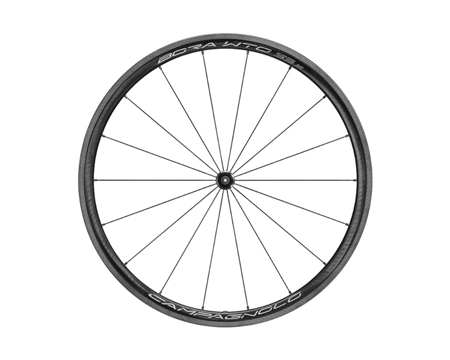
In the fall of 2015, a representative of Campagnolo approached me at a world cup. He explained that they were producing a new track wheel and asked if I might be interested. They were producing a limited number in time for Rio as these wheels were handmade and they could only produce 1 per day at their factory. I kid you not!
We placed an order for one set with the option to take another 12 pair that would arrive before the games.
I received this first pair of wheels in the winter of 2015/16. They were expensive. Really expensive for a little Canadian federation. About $4000 CAD per pair. But, they were incredible. Imagine a drum skin, a couple MM thick. Now, suspend a hub in the middle of a carbon fiber drum skin. Not figuratively mind you, literally suspended. This was referred to as a tension disc. Basically, how a traditional wheel is built. Carbon rim, a few spokes, and a track hub. Then a carbon canvas is bonded to the sides of the hub and the sides of the rim. Once the epoxy is cured the spokes are all removed and the tension is transferred from the spokes to the carbon canvas. This makes for an incredibly light weight, stiff, and delicate wheel. The pair was over a pound or about 500G lighter than the Mavic wheels we had been using before.
Through our aerodynamic testing system, we were able to determine that these wheels were only marginally more aero than the old Mavic wheels, not significant enough to justify the possible expense of $48,000 CAD for 12 pair. The rotational weight of these wheels was significantly lighter. Rotational weight has a significant effect on acceleration and this could potentially play a role in our times not only for the women’s team pursuit but more importantly the Women’s team sprint. We qualified two talented athletes, Calgary’s Kate O’Brien and Monique Sullivan. This was more significant for the team sprint as that event was only two laps. A 35 second event. If we can save ½ a second or more on the opening lap, that can be the difference between a medal and 5th place.
We needed data to justify this expense. An expense that would later have very significant impact on the men’s team. I’ll get to that in a bit.
Mike spearheaded this experiment and reached out to Andy Froncioni, an engineer from Montreal and founder of Alphamantis. Andy’s company created the track aero system we used to improve aero positions, test equipment, and generally take a data driven approach to every piece of kit we used. Mike and Andy figured that if we could calculate the moment of inertia between our old Mavic wheels and the new Campagnolo Ghibli wheels, they could calculate the time savings over 250 meters of the first lap in a track race. Consider accelerating a bike from a dead start to around 60kph. To do this, I built a simple jig that hung a weight on an arm from the axle of our wheel. Mike then used a high-speed camera to measure how quickly the weight swung under the wheel when we lifted the weight to a certain height. With the arm fixed to the wheel, the inertia of moving the wheel could me measured. They calculated the difference and found that this lightweight Campagnolo wheel would save 0.5 seconds over the first lap.
You might be saying what, seriously 0.5 seconds. That’s nothing for nearly 50,000 dollars. We lost the world championships in 2014 by 2 seconds. Races are decided by tenths regularly, especially in the team sprint! We tested these wheels in training and the stop watch corroborated the data calculated with our moment of inertia jig. I ordered 12 sets of Campagnolo Ghibli wheels.
Investment
Recently in the media there has been a firestorm of vitriol for Cycling Canada over the reinvestment of funds away from Women’s team pursuit. I don’t really want to comment on this despite my history and opinions on it. I will say this though. When we bought those wheels, Chris and I knew that we didn’t have the money for them. The equipment budget was all spent. We did it anyway because the calculated gain and our desperate need for a medal in Rio justified it. That money needed to come from somewhere. We took it from the Men’s endurance program. Those boys either couldn’t race or had to pay their own way to races the next year from a direct decision we made to support the women’s chances. Whatever is happening at Cycling Canada right now is in no way sexist, its just a few people making the best decision they can with the data they have been able to attain, sometimes you are the hammer and sometimes you are the nail.
To Tire or not to Tire
Our final piece of kit for the games was tires. If you thought the frames and handlebars were a Snafu buckle up for this one.
Our team used Vittoria tires. Most teams used Vittoria tires. Our men’s road team was sponsored by Vittoria and I received hundreds of road tires annually for a couple years as well as purchasing somewhere In the range of 20K CAD for track tires. Those track tires would last at most three months and cost me $100 each. I did more business with Vittoria than most Canadian bike shops. I also glued a lot of tubular tires. Back in those days, we glued racing tires to the rims, They were called tubulars. 11 years, min 200 tires per year. Somewhere in the range of 2000 tires glued onto the rims with a form of contact cement. Not only do I have no sense of smell any longer but I am easily in the top three living Canadians for this particular and archaic skill. Only Geoff Brown and Jeff Crombie will have surpassed me.
In the spring of 2016 I was contacted by somebody from Vittoria. I don’t remember his name, but he was a native English speaker, I know that much. He told me about a new Vittoria tire for the Rio Olympics and that this tire would be available in limited quantities for the teams. He was asking me how many I wanted. He was also specific that I wouldn’t necessarily get as many as I wanted but he wanted to know my order for this yet to be seen tire. I took a guess and asked for 10, 19mm tires and 20, 22mm tires. $150 each. He said they would be the lightest and fastest tire they have ever produced. Okay, sure I said. Send me the bill.
I received these tires a few months later. Literally two weeks before we flew to Brazil.
These tires were incredible, They weighted nothing! Imagine taking a bike tire, and instead of a nice rubber tread, spray some silicone over a single layer of silk. I mounted a set on one pair of wheels as a test, the coaches were interested but cautious. They lasted ten laps… 2.5 kilometers.

So delicate that anything on the track will tear them.

The picture above shows the tire after 10 laps of use. If you look closely, the rubber in the second picture is delaminating from the casing it’s bonded to. This tire was also unique in that it was all grey, the whole thing was grey! No carbon black added to the rubber, just some sort of latex or silicone for a tread.
After this initial test Craig, Mike, and I agreed that we would mount 7 pair and hold these 7 sets of wheels in reserve for the finals. 2 for team sprint, 4 for team pursuit, 1 spare. I would mount another sacrificial pair and each rider, sprint and pursuit would get to ride them to get a feel for the new tire. We would then run the normal and reliable tires for qualifying and our training leading up to the games. It never came to that.
I received a phone call from this mystery man from Vittoria again a few days after receiving the tires. He basically explained that a few teams had been having issues with the new tires. They had determined that the bonding process between the tread and casing had not worked correctly and that the treads were delaminating. He continued to explain that he had been calling all the teams and explaining that Vittoria didn’t want any catastrophe on the world stage with this brand new tire. He asked me quite bluntly that I would promise not to use these tires in Rio.
It was a really weird conversation, he sounded desperate and I remember his question like it was today. “Dan, can you promise me you will not use these tires at the Olympics.” I asked him if other teams, namely the Brits and Aussies, had also made this pledge. He confirmed this and I agreed. We would use the normal Pista tire in Rio. When I arrived in Brazil I asked Ernie the British mechanic, a friend and mentor. He told me that they got 60 of the new tires. He mounted them all at their service course in Manchester. They loaded them up in a truck and drove to Wales for their holding camp with the Olympic team. The tires lasted less than a day. Another staff member had to collect new tires from the service course then drive overnight to Wales and take a ferry. Ernie and the other mechanic were up the rest of the night and the next morning glueing all new tires of the normal variety. I had it easy compared to him!
Rio to Tokyo
It was a long lead in, a lot of planning, spending, strategizing. A lot of work and looking back, we worked for two years with this singular purpose. My next games In Tokyo would be the same. Basically two years of rebuilding the program and two years of lazer focus into the games.
In the end I don’t have a lot of memories of Rio, honestly it was a blur or rather it wasn’t all that memorable. Sure, the racing was memorable and seeing those ladies on the podium was memorable but I can’t really tell you any interesting stories from my time in Brazil. We won a bronze medal in the team pursuit, a bronze in Women’s MTB as well with Catherine Pendrel. We were dialed, we had a good team of staff and athletes who knew what their job was and they executed.
Our reward for those four years was the joy, elation, and relief of seeing those ladies on the podium. The second reward was the funding to try again in four years, it ended up being 5 but you can’t predict a global pandemic.
How to Fly with 30 Bikes
My final lasting memory of the 2016 games wasn’t even at the games. It was in the Pearson Airport at 11pm on my way home. With the way accreditations work at the Olympics, when your event is over your pass to the village essentially ends. This meant that we needed to get a bunch of our track staff out of the village right after the track events so that our BMX and MTB staff and athletes could get in.
Flights from Rio to Toronto only ran direct every second day. A direct flight with 30 bike boxes is really important. This meant that I would have to fly a day later than the other Canada bound staff by myself, with all the track equipment. I’ve talked about breaking airports and luggage before in another blog so I won’t go over that again.
Simply put, it was ridiculous and I arrived by myself in Pearson and collected some 40 pieces of luggage. I went to an Atm and took out $200 dollars. I found 4 porters and handed them 50 dollars each. I said I need this all out of here and into a Uhaul outside. So, imagine this, I walked up to the customs agent with my customs declaration, followed by four porters and 40 pieces of luggage on 8 of those flat bed trolly’s. He looked at me with a very serious face. “What is this, what are you doing” he asked quite bluntly. “I am team Canada’s mechanic, I am returning from the Rio Olympics, and I drew the short straw.” He stamped my declaration and waved me on without a second word.